
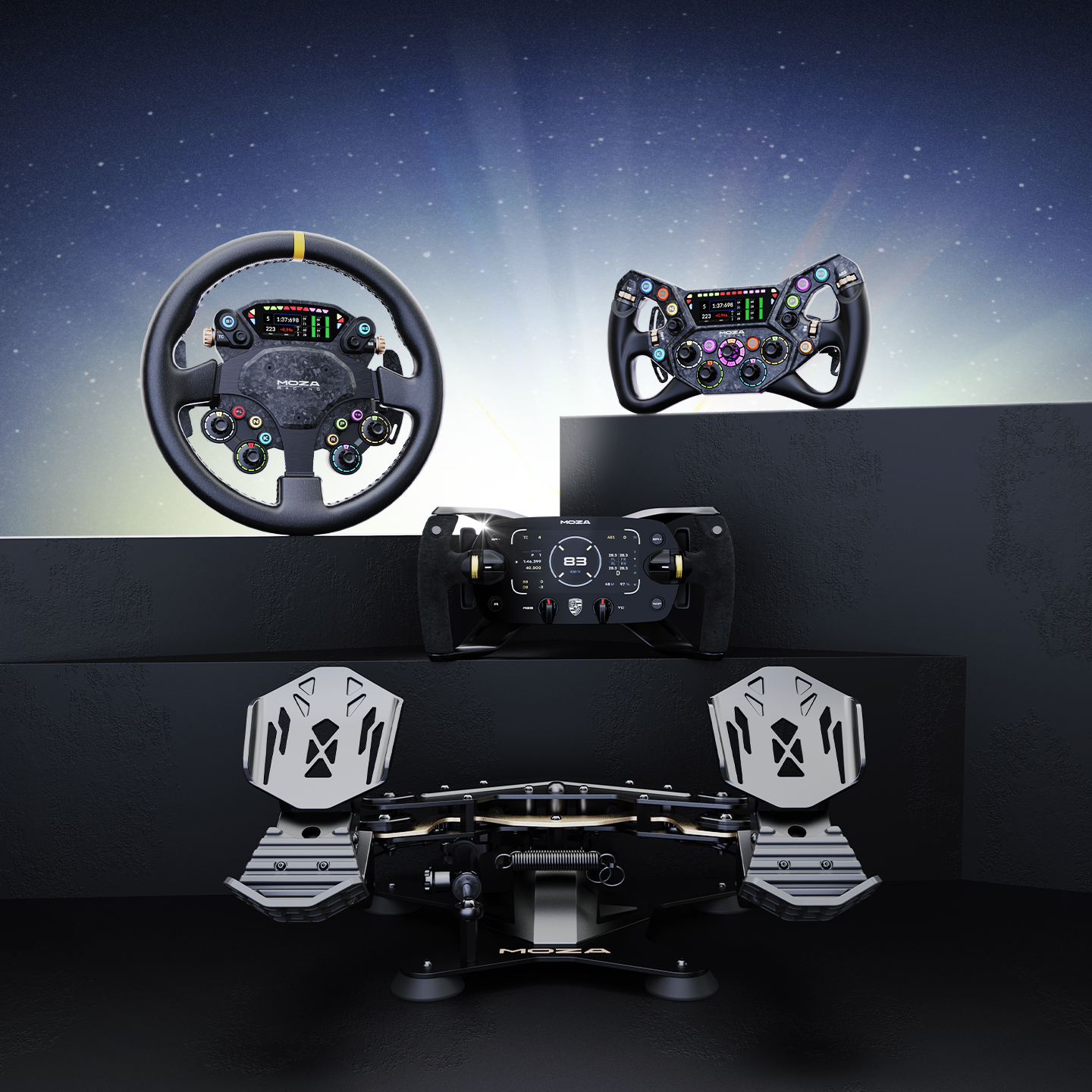
A sim racing rig can replicate the wheel, the pedals, and the visuals. What it cannot replicate by default is the physical sensation of the car moving beneath you. That missing layer, the one your inner ear expects and doesn't receive, is exactly what a motion simulator is designed to address.
For years, this technology remained locked inside professional motorsport facilities. Today, it sits in spare bedrooms and home offices. Understanding how these systems work strips away the mystery, revealing a fascinating intersection of software algorithms, electromechanical engineering, and human biology.
What a Motion Simulator Actually Does
A motion simulator in sim racing converts real-time telemetry data (like g-forces, suspension travel, and surface texture) into physical movement through electrically driven actuators. Motion cueing algorithms compress real driving forces into the platform's travel range, creating sensations that the driver's body interprets as acceleration, braking, and cornering.
Real racing generates massive sustained loads, such as the roughly 4-5g experienced by a Formula 1 car under heavy braking into Monza's Turn 1. A rig in a standard room cannot physically move far enough to replicate that literal trajectory.
The key distinction: Motion simulators do not replicate a car's actual path through space. They replicate the onset of movement. By delivering the initial jolt or weight transfer accurately, the hardware leads the brain to interpret the onset cue as a sustained force, even when the seat has barely moved.
To achieve this efficiently, the MOZA HMA150 utilizes a standard 3DOF (Three Degrees of Freedom) configuration covering pitch, roll, and heave. These three axes deliver the most impactful physical cues for driving. Its four-axis hardware layout distributes the mechanical load across an additional strut, improving force delivery and providing redundancy for vertical heave movements.
From Game Data to Physical Movement
The journey from a digital tire locking up to a physical jolt in the chassis happens in milliseconds. It follows a strict four-stage signal chain.
Telemetry Extraction
The sim title outputs raw physics data continuously. Lateral and longitudinal acceleration, suspension travel, yaw rate, and road surface texture stream out of the game engine dozens to hundreds of times per second. This data serves as the raw material for movement.
Motion Cueing Algorithms
Proprietary software directly handles the translation. Because algorithms within control centers like the MOZA Motion Manager must compress real-world forces into a limited physical space (often just 150 mm of actuator travel), they rely on a technique called a washout filter. This software commands the platform to deliver a sharp initial movement, simulating the onset of a force. It then gradually returns the seat to neutral at a speed below the driver's threshold of perception, freeing up the platform's travel for the next physical event.
Actuator Response
Electromechanical struts execute the software's commands. These motors must move with extreme speed and precise positioning to maintain synchronization with the on-screen action. Any mechanical hesitation breaks the illusion entirely.
Human Perception
The vestibular system in the inner ear detects acceleration, while mechanoreceptors in the skin feel pressure against the racing seat harnesses. When these physical sensations align directly with visual cues from the monitor, the brain accepts the movement as real driving physics.
What Separates a Convincing Motion Platform from a Gimmick

Massive stroke length provides little benefit if the actuators lack the acceleration to respond to inputs instantly. The inner ear responds to the speed of the initial motion, rather than the total distance traveled. This is arguably the single most misunderstood aspect of motion simulation: travel sells on spec sheets, but acceleration sells the illusion.
Speed and Latency
If platform movement lags behind the visual input, the physical disconnect breaks immersion; latency beyond roughly 30-50 ms is generally where many users begin to experience discomfort. Executing a Scandinavian flick on Finnish gravel in a Toyota GR Yaris Rally1 requires a rapid roll reversal within a tight 300-400 ms window. Meeting that window demands processing telemetry faster than human perception thresholds. By running a 600 MHz processor, the MOZA HMA150 keeps actuator commands synchronized with an ultra-low latency of just 8 ms during these rapid directional changes, while actuator speeds of 300 mm/s ensure the physical onset cues arrive before the brain notices any delay.
Resolution and Smoothness
Stepped or jerky movement shatters immersion. The internal components must render micro-movements seamlessly. The HMA150's 21-bit magnetic encoder, delivering approximately 2.09 million counts per revolution, ensures that subtle weight transfers feel smooth and continuous, completely eliminating any stepping or notching sensation common in entry-level platforms.
Frequency Range
Real driving produces a wide spectrum of physical inputs. While standard competitive platforms are commonly limited to a 100 Hz bandwidth that smooths out the terrain, MOZA pushes high-frequency vibrations up to 150 Hz. This extracts fine tarmac texture and high-frequency tire vibrations, transmitting subtle surface details directly through the seat.
Force at Payload
Acceleration specifications without payload context are essentially meaningless. A platform built around purpose-designed servo motors, like the MOZA HMA150, can deliver 1g of acceleration under a 250 kg payload because the motor was engineered specifically for the torque density and thermal demands of sustained motion cueing, not repurposed from industrial automation. Even under a heavy 350 kg payload, this architecture maintains 0.45g of acceleration, supporting extensive aluminum profile cockpits with multiple peripherals.
Geek Note: The Physics of Payload and Force This drop in acceleration from 1g to 0.45g is purely governed by Newtonian physics: F = m · a, where F is the constant thrust force of the servo motors, m is the total mass (payload + chassis), and a is the peak acceleration. Rearranging gives a = F / m. As the mass of high-end cockpits increases, the fixed force of the motors naturally yields a lower maximum acceleration, highlighting why measuring acceleration with a stated payload is the only honest metric.
Power, Safety Architecture, and Design
Historically, achieving high dynamic loads required bulky 220 V industrial drive boxes and separate servo motor controllers. The MOZA HMA150 embeds these control components directly into its dedicated actuator housings. Running on a safe 48 V low-voltage DC system eliminates the need for industrial power delivery, streamlining installation. Beyond saving space, this architecture integrates RGB ambient lighting on the actuators, reflecting live telemetry states like ABS activation, traction control, and flag signals to add visual situational awareness directly to the cockpit.
Bridging the Non-Telemetry Gap: Unlocking AAA Games with AI Motion
Traditionally, motion simulation hardware remains dormant if a game doesn't output official telemetry data. This limits high-end rigs exclusively to racing or flight hardcore sims. To bypass this limitation, MOZA developed AI Motion.
Instead of relying on game engine physics, this AI-powered engine analyzes in-game visuals and audio in real-time. It actively translates non-telemetry scenarios (an "Event" like walking, firing a weapon in a shooter, or an environmental explosion) into a corresponding physical posture and vibration response (the "Effect") from a built-in Effect Library. This enables the hardware to instantly provide immersive feedback for massive AAA open-world titles, protecting the user's investment across entirely new gaming genres without waiting for official developer integration.
How Motion Simulation Complements Force Feedback

A common misconception is that a motion platform replaces the need for a high-end wheelbase. In reality, the two systems handle entirely different sensory channels.
Force feedback dictates the steering column's relationship with the front tires. It communicates grip loss, self-aligning torque, and the immediate resistance of the steering rack. Motion simulation dictates the chassis's relationship with the track and the vehicle's mass. It communicates weight transfer, suspension compression, and the physical inertia of the car body.
When these systems operate in tandem, the driver receives a complete telemetry picture. Feeling the rear of the car physically step out through the seat (motion) fractions of a second before the steering wheel goes light (force feedback) enables faster, more intuitive corrections. The chassis movement validates the steering cues, reducing the cognitive load required to interpret the simulator's physics.
Understanding the Terminology
Degrees of Freedom (DOF): The number of distinct ways a platform can move. Pitch (tilting forward/backward), roll (tilting side-to-side), and heave (moving straight up/down) constitute a 3DOF system.
Washout Filter: The software algorithm that imperceptibly returns an actuator to its center position after a movement, ensuring it has enough travel ready for the next impact.
Actuator: The electromechanical leg responsible for physical movement. High-end systems utilize precise ball screws rather than pneumatic or hydraulic cylinders.
Payload Capacity: The maximum weight (chassis, driver, and peripherals) a system can move while maintaining its stated acceleration and speed specifications.
Conclusion
Motion simulation represents a profound shift in how digital racing is experienced. By translating raw telemetry into precise physical forces, these systems effectively close the loop between visual input and bodily sensation.
The engineering challenge lies not in simply moving a seat, but in moving it with the speed, smoothness, and accuracy required to convince the human vestibular system. Every acceleration figure, every latency spec, every encoder resolution ultimately serves a single objective: making the washout filter invisible. When that algorithm does its job perfectly, the driver stops analyzing the hardware and starts driving the car. That's the benchmark that separates genuine simulation from expensive movement.
Continue Your Journey: The Sim Racing Motion Series
Want to dive deeper into motion simulation? Check out the other dedicated guides in our motion simulation series:
-
The Ultimate Guide: Sim Racing Motion Systems Explained
-
Part 2: Degrees of Freedom (DOF) in Sim Racing Explained
-
Part 3: What Do You Need to Run a Motion Simulator at Home?
Part 2: Degrees of Freedom (DOF) in Sim Racing Explained
Sim Racing Motion Systems Explained: The Ultimate Guide