
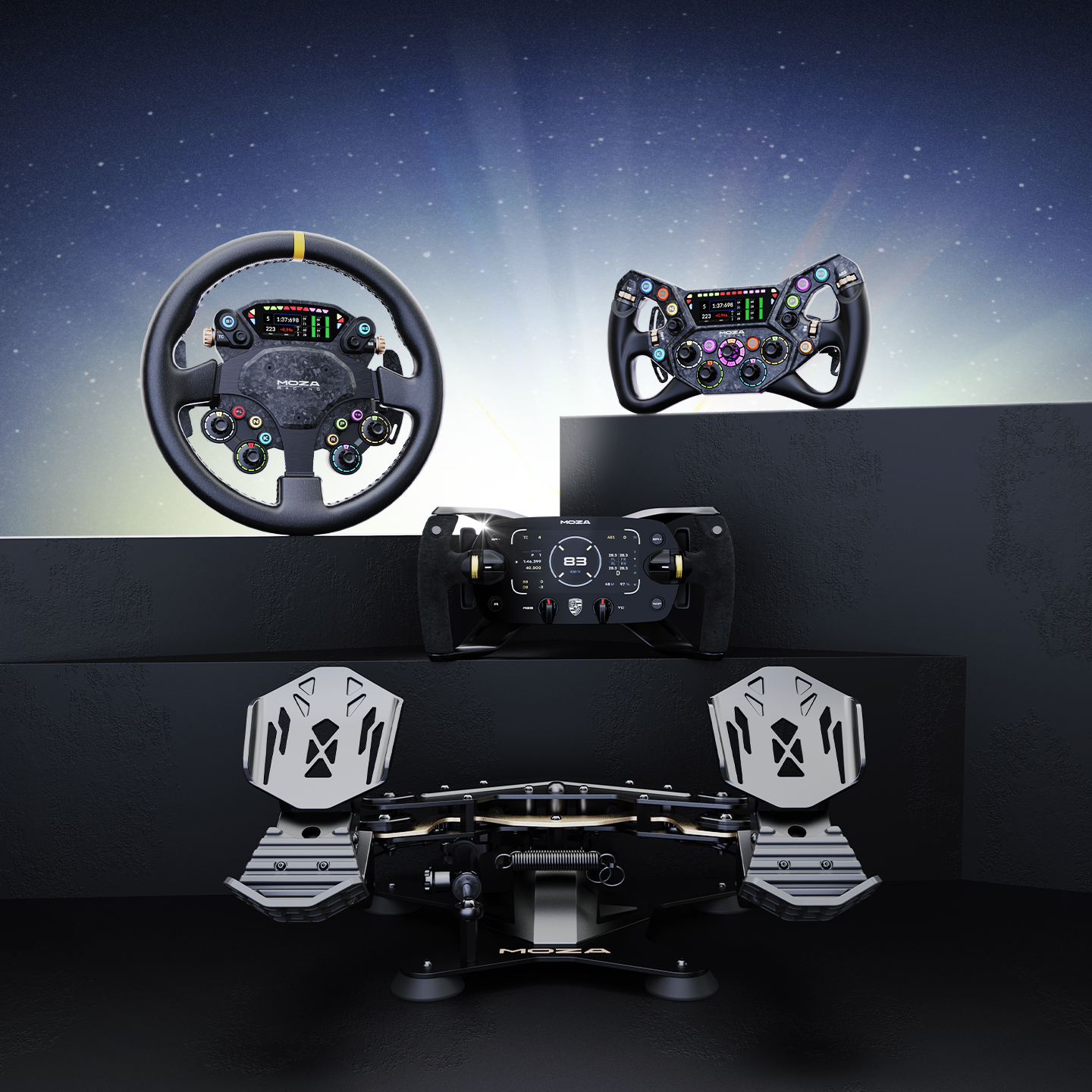
Truck simulation represents one of the largest and most dedicated communities in the digital driving space. Yet, when players look to upgrade from a keyboard or gamepad to a dedicated steering wheel setup, the available advice almost exclusively caters to motorsport. The hardware configuration optimized for shaving tenths of a second off a lap time in a GT3 car is ergonomically mismatched for hauling a 40-tonne load across the Alps in Euro Truck Simulator 2 or American Truck Simulator. Fortunately, modern direct drive ecosystems like MOZA's use a uniform quick-release standard across their entire wheel range, which lets a driver swap between a racing rim and a truck-specific wheel on the same wheelbase in seconds.
Commercial driving demands a completely different physical interaction with the vehicle. Rather than prioritizing peak torque ceilings and ultra-stiff load cell brakes, virtual truckers must focus on steering wheel diameter, rotation range, shifter authenticity, and ergonomic comfort over multi-hour sessions. Building a rig for the long haul requires rethinking standard sim racing conventions and selecting components designed specifically for the unique mechanics of heavy goods vehicles.
Why Truck Sims Demand Different Hardware
The core difference between racing and truck simulation lies in steering geometry and vehicle mass. A modern race car utilizes a fast steering ratio, often requiring only 540 degrees of total rotation from lock to lock. Small inputs translate to immediate directional changes. Conversely, commercial trucks rely on slow steering ratios, typically ranging from 20:1 to 24:1. To achieve maximum steering lock, a real-world truck driver must rotate the wheel through five or six complete turns (1800 to 2160 degrees).
This massive rotation range completely alters how a driver handles the wheel. Navigating a 16.5-meter articulated semi-trailer through a tight Manchester roundabout requires predicting off-tracking, where the trailer's rear axle cuts significantly inside the tractor's path. The driver must swing wide and unwind the wheel progressively through the apex. Leaving the wheelbase configured to the typical 900-degree default sim racing rotation forces an artificial sensitivity that breaks this immersion, making low-speed maneuvers feel twitchy rather than deliberate. Modern direct drive bases can be configured up to or beyond this commercial rotation range, so pairing a larger rim with the highest practical rotation setting in the simulator's settings is the single change that most directly improves low-speed control.
Furthermore, force feedback in commercial driving serves a different purpose than in motorsport. A GT driver relies on high-frequency feedback to detect tire slip angles and curb textures. A truck driver relies on low-frequency, high-amplitude forces to sense the self-aligning torque of the front axle, road camber, and the shifting weight of a heavy trailer. The physical feedback is about communicating momentum and resistance rather than the razor-edge limits of grip. Consequently, the hardware needed to replicate a Volvo FH16 or a Scania R-series must prioritize smooth, sustained rotational resistance over violent, sudden force spikes.
The Steering Wheel: Size and Layout Matter

The most immediate ergonomic mismatch in a repurposed racing rig is the steering wheel rim itself. Standard sim racing wheels typically measure between 280mm and 320mm in diameter. Real commercial trucks utilize much larger rims, generally spanning 450mm to 500mm, to provide the necessary mechanical leverage over heavy steering systems.
Using a compact, flat-bottomed formula wheel to back a 13.6-meter trailer into a blind-side dock at the Calais ferry terminal feels inherently wrong. The small diameter forces hyper-sensitive inputs, while the lack of a full circular rim makes hand-over-hand steering nearly impossible. A purpose-built, large-diameter round wheel brings the correct geometry straight from the cab into the rig. A 400mm 4-spoke design like the MOZA TSW, with its microfiber leather rim and 14-button face plate, serves as an excellent middle ground for simulators, offering realistic leverage without demanding a full-scale commercial cockpit enclosure.
Material choice also plays a critical role in long-haul comfort. Suede and Alcantara grips are designed for use with racing gloves and will degrade quickly under the constant friction of bare hands sliding through the 1800 degrees of rotation typical of low-speed truck maneuvers. Smooth leather, microfiber, or high-quality rubber compounds provide better durability and comfort for continuous hand-over-hand maneuvers.
Beyond shape and size, commercial driving requires constant interaction with cabin controls. A truck dashboard houses dozens of functions: retarder stages, differential locks, trailer brakes, range selectors, and lighting controls. A wheel equipped with localized thumbwheels, joysticks, and backlit buttons allows drivers to manage these systems without breaking their visual focus on the road. Navigating a route advisor or adjusting mirrors becomes a seamless part of the driving process when the controls are integrated directly into the wheel hub.
Choosing the Right Wheel Base: Torque vs. Endurance

Direct drive wheel bases have become the gold standard in simulation, but the rationale for using one in a truck simulator differs entirely from circuit racing. In motorsport, drivers chase high torque figures to feel the sudden, violent transitions of a car losing traction. In truck simulation, a wheel base rarely needs to output more than a moderate level of sustained force.
The Argument for Direct Drive in Trucking
The true advantage of direct drive for long-haul driving is thermal stability and acoustic silence. Belt-driven and gear-driven wheel bases rely on internal mechanical friction, which generates heat and noise. On a long-haul Calais to Stuttgart run, the constant whine of a belt-drive motor becomes a real distraction by the end of an evening session. A direct drive base operating well below its maximum capacity remains entirely silent and cool, providing a smooth, frictionless feeling that accurately mimics modern power-assisted commercial steering.
Output Levels and Rim Leverage
When selecting a base, output levels in the 5.5 Nm to 9 Nm range (delivered by bases like the MOZA R5 at the entry and the MOZA R9 V3 at the mid-tier) offer the ideal sweet spot for truck simulation. A larger 400mm truck rim requires more torque from the base to feel equally weighted in the hands than a 280mm racing rim, so a mid-tier direct drive base provides the headroom needed to keep steering feel substantial without causing shoulder fatigue during extended cruising. For drivers entering trucking simulation for the first time, manufacturers pair the entry-level components into ready-made kits: the MOZA Trucking Bundle, for example, combines a 5.5 Nm direct drive base with a 400mm truck rim as a complete starting point, with the option to step up to higher-torque bases like the R9 V3 once the discipline becomes a primary focus.
The Shifter: Where Truck Sims Earn Their Realism

For many virtual truckers, upgrading the transmission interface transforms the experience more than any other hardware change. While modern European trucks frequently utilize automated manual transmissions (such as the Volvo I-Shift or Scania Opticruise), the classic manual gearbox remains a cornerstone of the trucking experience, particularly in North American simulation.
Splitter and Range Functionality
Navigating a heavy load up the Brenner Pass requires precise gear management to maintain momentum. Commercial manual transmissions, like the Eaton Fuller 18-speed or various ZF gearboxes, do not operate like a standard six-speed car. They utilize range and splitter systems to divide a standard H-pattern into multiple high and low ratios. Climbing a steep grade might require flicking a splitter switch to drop half a gear, keeping the engine within its narrow optimal power band (typically between 1100 and 1400 rpm).
Sequential and paddle-only shifters cannot replicate this. The truck driver needs gate-by-gate engagement, which an H-pattern shifter handles most authentically. A robust, full-metal H-pattern shifter such as the MOZA HGP provides exactly that gate-by-gate engagement. On real Eaton Fuller or ZF transmissions, range and splitter switches live directly on the shift knob itself, hardware the most demanding sim-truckers complete with a specialty replica knob from a third-party builder. Short of that step, mapping range and splitter to the wheel-hub buttons of a dedicated truck rim, such as the MOZA TSW with its 14 backlit buttons and dual thumbwheels, keeps both hands on the rig instead of breaking grip for a keyboard before each shift. Without one of these two routes, the splitter falls back to keyboard or generic button-box bindings, breaking the mechanical rhythm of floating gears under a heavy load.. Whether executing a flawless shift on a Bavarian A-road or crawling through a quarry in low-range, a dedicated truck-style shifter paired with a properly mapped truck wheel hub is the defining element of a realistic heavy goods setup.
Pedals: Modulation Over Maximum Force

Pedal selection presents another area where racing logic fails the virtual trucker. In competitive motorsport, drivers rely on ultra-stiff load cell brakes to develop muscle memory for threshold braking. A GT3 car requires the driver to apply massive force and slowly trail off as the car enters a corner.
Commercial air brakes behave entirely differently. Truck braking is progressive and relies heavily on modulation rather than maximum physical force. When descending a six-kilometer mountain grade with 40 tons of cargo, a driver primarily uses the engine retarder, applying the service brakes only to scrub speed before tight hairpins. The brake pedal must allow the driver to hold a steady, moderate pressure for extended periods without inducing leg fatigue.
A pedal set with progressive resistance and meaningful throw mimics this air-assisted braking far better than a rock-hard racing pedal. The closest match to a real treadle valve actually comes from a load cell pedal fitted with a soft elastomer, since the load cell responds to applied force rather than travel and reproduces the spongy pressure build-up of an air brake under the foot. The MOZA CRP2 supports interchangeable elastomers that can be tuned toward exactly this softer, more authentic profile. For drivers entering trucking through the Trucking Bundle, the included Hall-sensor SR-P Lite pedals remain a capable starting point, with the CRP2 available as an upgrade once air-brake authenticity becomes the focus. Drivers planning to operate older manual trucks will also want to extend the two-pedal SR-P Lite set into a three-pedal configuration by adding the matching SR-P Lite Clutch, providing the travel needed to find the bite point when pulling a heavy trailer away from a dead stop.
Handbrake and Auxiliary Controls: The Authenticity Layer
The final layer of immersion in a truck simulator involves the auxiliary controls that drivers interact with constantly on every journey.
The Parking Brake
In a racing simulator, the handbrake is typically a rally-style vertical lever meant to induce oversteer. In a truck simulator, the parking brake serves an entirely different purpose: coupling trailers, securing the vehicle on steep loading docks, and applying the spring brakes when the rig must hold position. Real commercial cabs operate this function through pneumatic push-pull valves on the dashboard, and authenticity-focused builders sometimes assemble custom valve boxes to match. For most virtual truckers, however, the practical comparison is against a keyboard binding, and a dedicated lever such as the full-metal MOZA HBP delivers far more tactile, deliberate input, turning each securing maneuver into an engaging mechanical gesture.
Multi-Function Stalks

Equally important is the integration of multi-function stalks. A commercial driver's hands are constantly leaving the wheel to activate turn signals at every junction, toggle windshield wipers during sudden rainstorms, flash high beams on dark rural highways, and adjust cruise control speeds. Multi-function stalks mounted directly behind the steering wheel, such as the MOZA Multi-function Stalks with their 28 programmable switches covering wiper, headlight, and cruise control functions, transform the ergonomic flow of the cabin. They eliminate the need to hunt for buttons on a keyboard in the dark, keeping the driver's eyes on the road and hands on the rim throughout multi-hour deliveries.
Building a setup tuned for trucking is a deliberate choice. Each component, from the diameter of the wheel to the angle of the cab, contributes to a single goal: transforming a virtual seat behind the keyboard into the actual driving position of a commercial cab. The result is a simulation that earns its hours over long European nights, where the engineering of the rig becomes inseparable from the experience itself.
For drivers starting from scratch, the MOZA Trucking Bundle offers the most direct route into a dedicated truck simulator setup, while the HGP shifter, HBP handbrake, and additional cockpit controls can be added progressively as immersion becomes the priority.
Going Further
This pillar covers the broad principles. The companion articles in this hub dive into the specifics:
-
Best Sim Racing Wheel and Pedal Setup for Euro Truck Simulator 2 & ATS: game-specific recommendations and FFB calibration.
-
Truck Simulator Ergonomics: How to Mount and Position Your Wheel and Shifter: angles, heights, and rig geometry for multi-hour comfort.
-
How Much Torque Do You Really Need for Truck Sim Racing? (R3 vs R5 vs R9 V3): a side-by-side comparison of MOZA's entry, mid, and upgraded bases for trucking workloads.
Share:
Choosing Your Weapon: Paddle vs Sequential in Rally Sim Racing