
The most expensive way to build a sim racing rig is to buy the cheapest components first.
A common pattern sees drivers buying entry-level, gear-driven wheels to "test the waters," only to realize within months that the feedback lacks the detail required to catch a slide or feel the road texture. They eventually sell the gear at a loss and buy the mid-range setup they should have chosen originally.
A strategic approach focuses on a deliberate upgrade path. Instead of viewing the rig as a single purchase, experienced racers view it as a modular ecosystem where each component can be swapped or improved without rendering the rest of the hardware obsolete. By prioritizing the right components, specifically starting with pedals and ensuring the wheelbase relies on a unified quick-release standard, you can build a setup that scales from enthusiast lapping to competitive racing.
Why Most Sim Racers Regret Their First Purchase
The primary driver of buyer's regret in sim racing is not spending too much, but spending inefficiently. Entry-level hardware often relies on plastic gearing or belt drives that dampen the finer details of the physics engine. When a car loses traction, there is a delay between the software registering the slide and the wheel communicating it to your hands. By the time you feel it, it is often too late to correct.
The consequence: The hardware becomes a ceiling on your development. You aren't fighting the car; you are fighting the latency and lack of dynamic range in your equipment.
The solution: Shift the mindset from "buying a wheel" to investing in a platform. A modular ecosystem allows you to start with a strong foundation, a direct drive base and load cell pedals, and expand your collection of steering wheels over time. This ensures that every dollar spent contributes to the long-term build rather than being discarded in the next upgrade cycle.
The Foundation That Matters Most: Pedals First

If you have a limited budget to upgrade your rig, the most effective place to spend it is not on the steering wheel, but on the pedals.
While the wheelbase provides immersion, the brake pedal provides consistency. Entry-level pedals use potentiometers that measure travel (how far you press the pedal). However, human muscle memory, specifically proprioception, is significantly better at reproducing a specific amount of pressure than a specific distance.
Real-world context: Consider braking into the Variante del Rettifilo at Monza. You arrive at 330 km/h and must apply peak force instantly, then progressively bleed off that pressure over two seconds as you turn in. Doing this consistently based on pedal travel is incredibly difficult. Doing it based on pressure is natural.
This is why load cell pedals are the industry standard for consistency. They measure the force applied to the face of the pedal, mirroring the hydraulic systems in real motorsport.
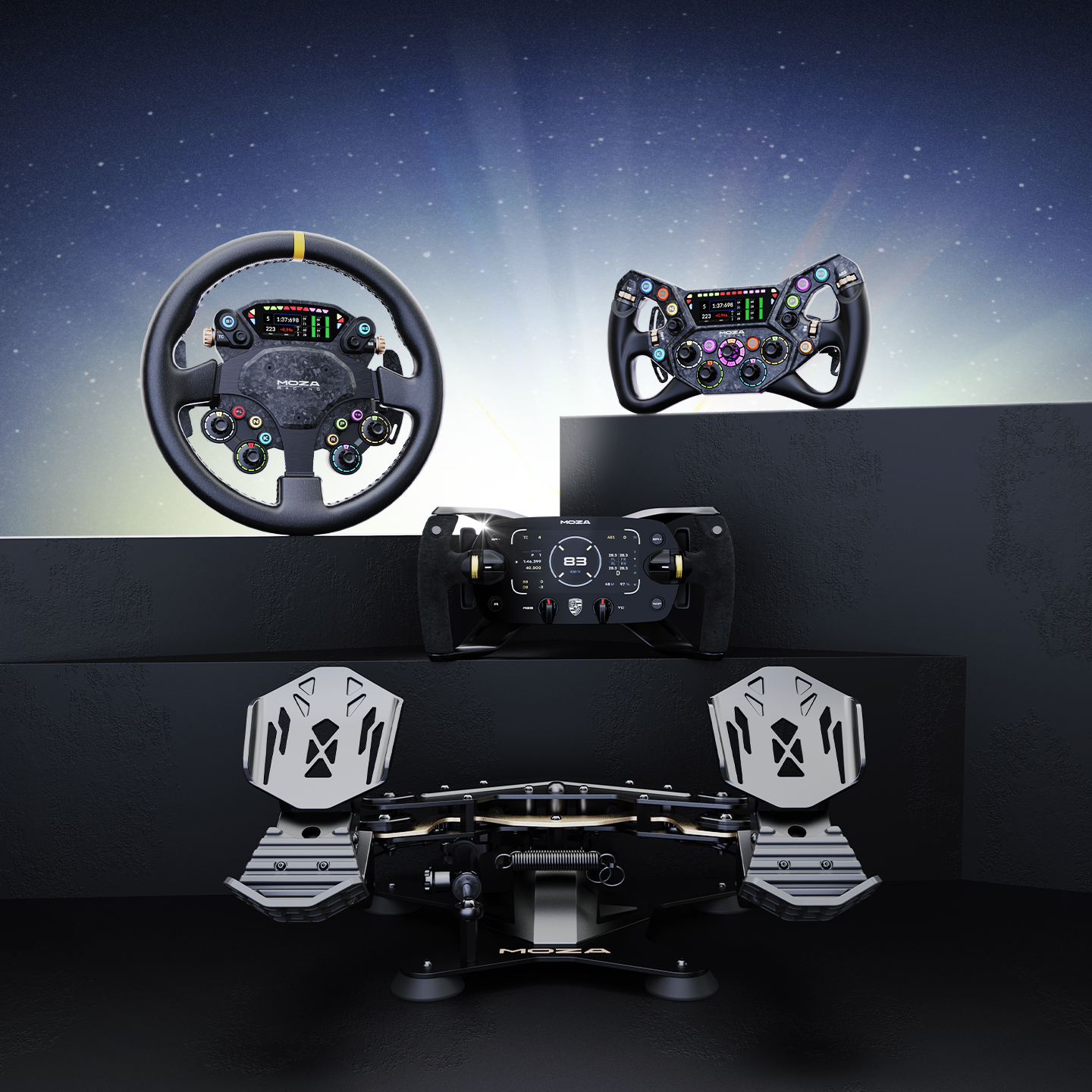
The equipment strategy: A pedal set needs enough structural rigidity and sensor range to grow with you. High-performance load cell sets, such as the MOZA CRP2, handle up to 200 kg of force, well above the 40 to 80 kg of peak force typical in real GT3 cars. That overhead keeps the sensor operating in its most linear zone and means you can start with a softer setting and progressively stiffen the brake pedal as your leg strength and technique improve, ensuring the hardware never becomes the bottleneck.
Choosing a Wheelbase You Won't Outgrow in Six Months

Once the pedals are sorted, the wheelbase becomes the center of the ecosystem. The goal here is to find the "torque sweet spot", enough power to replicate the physics without paying for force you will never use.
It is important to note that the high-performance direct drive bases discussed in this tier (MOZA R9, R12, and R21) are PC-only platforms. This focus allows for higher data bandwidth and advanced software customization, which are critical for the fidelity required at this level.
The Threshold of Detail: 9 Nm
The jump from gear-driven bases to direct drive is a fundamental shift in fidelity. In a direct drive system, the steering wheel mounts directly to the motor shaft, eliminating all mechanical play.
For most drivers, 9 Nm of output (the level provided by a base like the MOZA R9) creates a solid baseline for simulation. It delivers enough force to communicate weight transfer, road texture, and the lightening of the steering caused by understeer. It provides the fidelity needed to feel the car's limits without the signal feeling compressed.
The Case for Headroom: 12 Nm
If 9 Nm is sufficient, why do 12 Nm bases exist? The answer lies in dynamic range and clipping.
Clipping occurs when the simulator requests more force than the motor can deliver. Imagine driving the descent at Bathurst through The Chase. The suspension is fully loaded, generating high self-aligning torque (perhaps 8-10 Nm). If you hit the curb, the physics engine might request a spike of 12 Nm to simulate the impact. If your base maxes out at 9 Nm, that detail is lost, the signal is "clipped" flat.
The upgrade logic: Stepping up to 12 Nm, as with the MOZA R12, provides meaningful headroom over the 9 Nm tier. This does not necessarily mean you run the wheel heavier; it means you have reserve power. You can run the base at a comfortable weight for GT3 racing (roughly replicating the forces felt in real power-assisted GT3 steering columns) while still retaining the capacity to deliver sharp, unclipped jolts from curbs or collisions.
Wheels: The Part You Swap, Not Replace

In a modular ecosystem, the steering wheel rim is a tool, not a permanent fixture. Because MOZA utilizes a uniform quick-release standard across its entire ecosystem, a wheel purchased today will fit any MOZA base you might upgrade to in the future.
The versatile starting point: For a driver building their first serious setup, a round wheel offers the most utility. A 325 mm rim diameter matches real-world GT and touring car specifications, and a round shape like the MOZA CS PRO provides the correct leverage for the 12:1 to 15:1 steering ratios found in those cars, ensuring your inputs translate accurately to the virtual vehicle.
Why shape matters:
-
Rally and Drift: Techniques involving rapid rotation require the continuous surface of a round rim.
-
GT and Touring: While some modern GT3 cars use open-top wheels, a round wheel handles circuit racing without compromise.
Material durability: Look for materials designed for longevity. Microfiber leather, used on rims like the CS PRO, maintains consistent grip levels even as your hands sweat during long stints, offering excellent durability for daily use.
As your interests specialize, you can add a Formula-style wheel for open-wheel racing. This is an expansion of your toolkit, not a replacement of your original round wheel.
When to Upgrade - and When to Wait
The urge to upgrade is constant in sim racing, but the decision should be driven by specific, observable limitations in your driving, not by the release of new hardware.
Signs you are ready to upgrade:
-
Constant Clipping: If your software shows the force feedback signal creates a flat line during cornering (clipping) despite lowering the gain, your wheelbase lacks the dynamic range for the cars you drive.
-
Pedal Inconsistency: If you can visualize the braking trace you want but cannot reproduce it physically because the pedal feels inconsistent, load cells will fix this.
-
Flex: If you feel the pedal plate or wheel rim bending under load, that flex is absorbing detail that should be going to your hands or feet.
Signs you should wait:
-
Lap times are improving: If you are still finding time every week, your hardware is not the limiting factor.
-
Lack of setup knowledge: Often, a "weak" wheelbase just needs better software tuning. Spend time refining the equalizer settings in your FFB software before spending money.
The aspirational tier: For drivers who eventually outgrow the mid-range, perhaps those simulating vintage Formula 1 cars without power steering or modern high-downforce prototypes, the ecosystem scales up. A 25 Nm base like the MOZA R25 Ultra ensures that even the strongest forces requested by the simulator are reproduced without scaling down, which is the single most convincing argument for flagship hardware.
Building a Setup That Lasts: A Practical Roadmap

A strategic upgrade path avoids redundancy. Instead of buying a "beginner bundle" and selling it all later, build in stages:
Stage 1: The Foundation
A load cell pedal set, a 9 Nm direct drive base, and a versatile round wheel, such as the MOZA CRP2, R9, and CS PRO respectively, form a foundation capable of competitive lap times across disciplines.
Stage 2: Specialization
Once you know what you love, add a specialized rim. If you focus on Formula or GT3, a butterfly-style wheel like the KS PRO offers better visibility and ergonomics for short steering ratios. Your round wheel stays in the reserve for rally or drift sessions.
Stage 3: Refinement
Only when you consistently run into the torque limit of your base should you look at the motor. Moving from 9 Nm to 12 Nm or 25 Nm is the final step, adding immersion to a rig that is already mechanically sound.
By following this path, every piece of hardware you buy serves a long-term purpose. This approach transforms a collection of hardware into a cohesive, long-term simulator build.
共有:
長期にわたるシムレーシングハードウェア:エントリーレベルのホイール以外で注目すべき点
Using the Brakes to Control the Car in Rally Sim Racing